
Lara Inglis – Jones
Tom Cruise’s final mission is high on stunts, light on payoff.
“Our lives are the sum of our choices.”
This reflective line from Mission: Impossible – The Final Reckoning, the final instalment of the Mission: Impossible franchise, is meant to echo main character Ethan Hunt’s journey, a legacy of sacrifice, loyalty and impossible missions.
But it also became a personal reflection as I sat down for the nearly three-hour film, only to leave the cinema questioning whether my own choice to watch it was a worthy one.
Great Plot, Slow Build-up
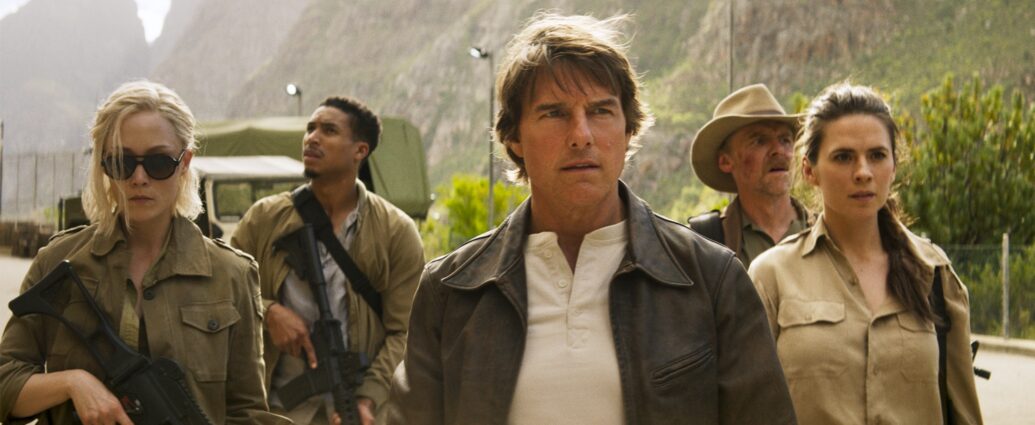
The film, initially titled Mission: Impossible – Dead Reckoning Part Two, picks up where Mission: Impossible – Dead Reckoning Part One left off. Ethan Hunt (Tom Cruise), along with his trusted team — Grace (Hayley Atwell), Luther (Ving Rhames) and Benji (Simon Pegg) — faces off against a rapidly evolving AI threat known as The Entity.
The Entity isn’t just any villain. It’s an omnipresent digital force, manipulating data, fabricating realities and destabilising global powers through disinformation and deepfakes. It’s a timely and terrifying concept, making the film’s stakes feel more urgent and plausible than ever.
Yet despite its premise, The Final Reckoning stumbles out of the gate. The first act is weighed down by exposition — a full 30 minutes of narrative setup packed with flashbacks to earlier Mission: Impossible films, including callbacks to Mission: Impossible III and the mysterious “Rabbit’s Foot” device, now rebranded as the “Podkova module.” These scenes are meant to give weight to the story but instead bog it down.
At one point, Ethan has a surreal conversation with The Entity itself about the nuclear apocalypse, a sequence that feels more like it was generated by ChatGPT than scripted by veteran writer-director Christopher McQuarrie.
Once the exposition clears and the mission becomes clear — that is, stopping the Entity by using a cruciform key to access the Podkova device on a sunken Russian submarine, the Sevastopol — the film finally begins to take shape.
Action Sequences
This is where Cruise, as ever, delivers. The underwater sequences that follow are among the most impressive in the franchise’s history.
Cruise dives into the ocean depths in pursuit of the Podkova, filmed using special equipment designed for short 10-minute intervals. Reports have revealed the risk he took filming these scenes, with oxygen limitations raising the danger of hypoxia.
The tension is palpable, not just because of the narrative, but because Cruise really does seem to be risking his life for the shot. It’s thrilling, edge-of-your-seat stuff, and a reminder of what sets this franchise apart in an age of CGI excess.
From there, the action escalates as the team travels to South Africa, where The Entity’s mysterious digital bunker awaits. Here, the film ups the ante with yet another death-defying sequence: Cruise wing-walking on an aircraft flying at 145 mph.
According to a recent Empire interview, Cruise even passed out during filming, struggling to get back into the cockpit. It’s jaw-dropping and absurd in the best way, a testament to the film’s ability to suspend disbelief and dazzle with real, visceral stunts.
But while the film shines in these moments, it falters again in its final act. The climax offers 30 minutes of high-octane action, but it ultimately fails to deliver an emotional or narrative payoff worthy of a franchise finale.
Despite the noise, explosions, and scale, something feels hollow. There’s no true sense of resolution, no clear farewell to Ethan Hunt or the team we’ve followed for decades. The adrenaline is there, but the heart is missing.
Performances
Nobody goes into a Mission: Impossible film expecting Oscar-calibre performances, but The Final Reckoning feels particularly thin on character work.
Cruise’s Ethan Hunt has increasingly become less man and more myth. The script leans into his almost supernatural ability to survive, making his character feel distant and untouchable. While Cruise’s physical commitment is undeniable, his performance lacks nuance; he’s playing a symbol more than a human.
Pegg and Rhames reprise their roles with reliable charm, but both are sidelined with minimal screen time and little development.
Atwell, who brought energy and wit to the previous film, feels weighed down here. The gravity of the situation has drained her character of the spark that once made her fun to watch. Her performance is competent but increasingly one-note, more grim determination than charisma.
Cinematography and Direction
McQuarrie, now a longtime collaborator with Cruise, continues to deliver sleek, high-concept action with style. The film is visually stunning in places, especially the underwater and aerial sequences, and McQuarrie knows how to build suspense through physicality rather than effects.
That said, his tone here is noticeably more serious than in previous entries, and not always to the film’s benefit. There’s less humour, less lightness and, at times, the seriousness verges on self-parody.
The film’s themes — AI, misinformation, global conflict — are timely and important, but they’re not always handled with the depth they deserve.
There’s an earnest attempt to ground the spectacle in meaning, but the script can’t seem to decide whether it wants to be a tech-thriller or a nostalgic greatest-hits tour of Ethan Hunt’s career. As a result, it ends up doing both, and doing neither particularly well.
Final Verdict
Mission: Impossible – The Final Reckoning is a film of extremes. At its best, it offers some of the most thrilling stunts and set pieces the franchise has ever produced. At its worst, it’s overlong, overcomplicated and emotionally underwhelming.
For longtime fans of the franchise, there’s still plenty to enjoy — especially if you’re in it for the action and the spectacle. But as a conclusion to one of Hollywood’s most iconic action series, it feels oddly incomplete.
As I left the cinema, I found myself revisiting that opening line:
“Our lives are the sum of our choices.”
In this case, my choice to see the film wasn’t a mistake, but it wasn’t quite the satisfying finale I was hoping for either.
READ NEXT:
- HAIM — ‘RELATIONSHIPS’ REVIEW
- REVIEW: DUA LIPA AND TROYE SIVAN ‘PHYSICAL’
- ADOLESCENCE: A CRITICAL VIEW OF MODERN-DAY SOCIETY
Featured image courtesy of Unification France on Flickr. No changes were made to this image. Image license found here.
Lara Inglis-Jones

I am a 23 year old MA student studying Security Studies at UCL. I love writing in my spare time.