
Sophie Barbe
As of right now, China is using legislation such as the National Security Law (NSL) and Article 23 to encroach on the rights of Hong Kong citizens. This legislation should be revoked, and the international community should be doing more to help.
Recently, on 19th March 2025, Amnesty International published an article asking for “the Hong Kong and Chinese governments to immediately repeal Article 23, the NSL and other legislation which violates international human rights laws and standards”. But what are the NSL and Article 23 – and why are they so harmful?
The NSL, Article 23 And China’s Abuse Of Power
Hong Kong’s History With Britain
Hong Kong is a semi-autonomous region of China, gaining this status after 99 years of British colonial rule, which ended in 1997 when Britain handed Hong Kong back to China.
Soon after, the British and Chinese formed an agreement allowing Hong Kong to have its own mini-constitution: the Basic Law. This allowed the region to retain certain freedoms, including the rights of assembly and free speech. In this way, Hong Kong retained its democracy and remained separate from Chinese authoritarian rule.
China’s Abuse Of Hong Kong
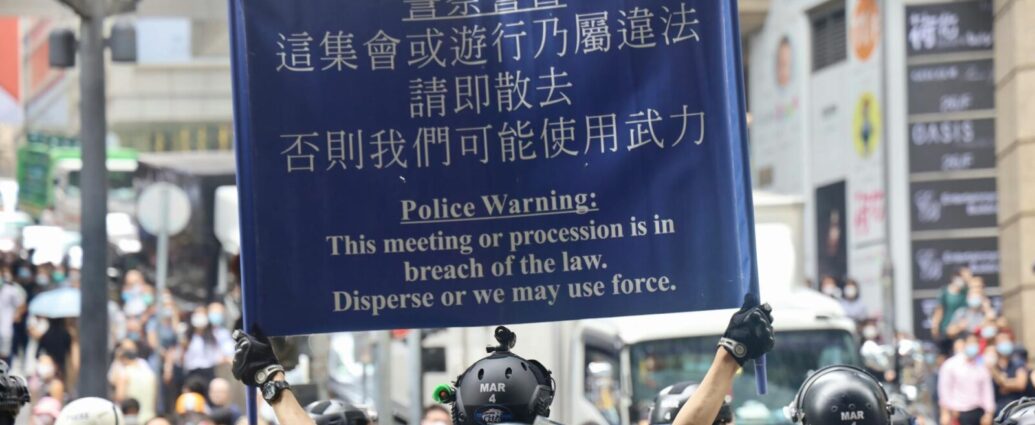
However, China has not honoured the agreement. Instead, they’ve cracked down on dissent in Hong Kong, responding harshly to protests in the region. This is most evident in the 2019 protests against China’s proposed extradition bill, where police attacked protestors using canons, rubber bullets, and tear gas. This violent treatment of protestors encroached on rights that were meant to be protected under the Basic Law. Whilst Western media covered these shocking events, their governments did little to prevent such gross violations of human rights from taking place.
“…it is their handover to China that has left the region in such a dire position in the first place.”
China’s introduction of a law to “protect” national security in 2020 sparked even more protests as it further threatened to impose limits on the freedoms of Hong Kong people. Its vague terms have been used to persecute anyone who disagrees with the Hong Kong and Chinese governments. It also allows cases to be tried in mainland Chinese courts, which have a conviction rate of 100%, and further enables authorities to place suspected “criminals” under surveillance.
Adding to this, in 2024, China introduced Article 23, allowing police to hold suspects for up to 16 days without charging them and increasing the list of punishable offences.
“Freedom of speech and democracy are part of the fabric of Hong Kong society. The removal of this is devastating…”
As Amnesty International’s Director Sarah Brooks pointed out, “Freedom of expression has never been under greater attack.” It is sad to see the Chinese government intimidating such a thriving democracy into silence through brutal punishment and repression. This not only violates human rights, but also breaks the agreement China made with Britain, so why isn’t anyone addressing it?
How China Encroached On Hong Kong’s Freedoms
Hong Kong’s protests have been a proud symbol of its democratic status, but China has now made these protests a punishable offence. Since the NSL was passed, 45 pro-democracy activists have been arrested, including student Joshua Wong, who was only 20 at the time.
“As freedom of speech is an integral principle of journalism, Western journalists have a responsibility to spotlight China’s attempts to repress this…”
The laws have proved especially detrimental to journalists. Authorities raided and shut down Apple Daily, Hong Kong’s pro-democracy newspaper, for breaking the NSL. This led to the arrest of billionaire Jimmy Lai, who founded the newspaper. Lai has been in prison since his arrest in 2020 and pleaded “not guilty” to all charges.
At another pro-democracy newspaper, Stand News, journalists Chung Pui Kuen and Patrick Lam have also been found guilty under the NSL.
Freedom of speech and democracy are part of the fabric of Hong Kong society. The removal of this is devastating for the region’s national identity. The lack of awareness and media coverage of the events in Hong Kong is, therefore, surprising, as journalists have been one of the groups most affected by the laws. As freedom of speech is an integral principle of journalism, Western journalists have a responsibility to spotlight China’s attempts at repression and raise awareness about the silencing of their Hong Kong counterparts.
Migration To The UK
Unsurprisingly, much of the population is fleeing Hong Kong as they no longer feel safe. In 2021, the UK government allowed Hong Kong overseas nationals to apply for British visas. Just four months later, they reported that 34,000 people applied.
It is now estimated that around 180,000 have moved to Britain as a result of this policy.
But even this does not guarantee safety. Hong Kong has offered rewards of HK$ 1m (£103,000) for any information that could lead to the arrest of activists who have fled overseas.
“The policy allowing Hong Kong citizens to obtain UK visas is not enough.”
UK Foreign Secretary David Lammy has said, “We will not tolerate any attempts by foreign governments to coerce, intimidate, harass or harm their critics overseas, especially in the UK,” issuing his support for those who have moved to Britain, but is this enough?
Lammy claims that the UK will “not tolerate” China’s attempts to impose the NSL overseas, but what actions has the government taken to stop this? Western governments have been very vocal about condemning China’s actions, but have taken little action to back these claims or to pressure China to remove its autocratic legislation.
What Should Be Done About This?
Amnesty International “demands a response by governments worldwide,” and they are right to point out that Western governments have largely failed to hold China accountable for its “criminal acts.”
Britain has a responsibility to ensure Hong Kong retains its freedoms, as it was their handover to China that left the region in such a dire position in the first place.
The policy allowing Hong Kong citizens to obtain UK visas is not enough. Whilst it has allowed many to restart their lives away from China’s authoritarian grip, it is still a superficial policy that does little to tackle the root of the issue. If Britain is truly committed to protecting human rights, it should ensure that Hong Kongers no longer have a reason to flee their home.
World leaders, like the U.S., also have a responsibility to protect the rights of the people of Hong Kong, especially as the country positions itself as a supporter of democracy and protector of human rights.
Amnesty’s article is a step in the right direction, and its decisive stance is an encouraging call to action. Western media and governments need to hear this call and act now to protect democracy in Hong Kong before there is nothing left to protect.
READ NEXT:
-
THE POLITICS OF INSTAGRAM’S UPDATE: A POLARISING RESPONSE
-
GLOBAL TENSIONS TOWARDS CHINA’S POLITICS AT THE G7 SUMMIT
-
WE NEED TO ACKNOWLEDGE THE SACRIFICE OF PALESTINIAN JOURNALISTS
Featured image courtesy of LT Chan on Pexels. No changes were made to this image. Image licence found here.
