
Sarina Maloy
“This is Scooter Braun, bullying me on social media when I was at my lowest point. He’s about to own all the music I’ve ever made,” reads the photo attachment to a post made by Taylor Swift in late June of 2019.
Post-Swift’s online cancellation – a response to an incident now referred to as ‘Snakegate’ – the attached screenshot exhibits a 2016 post made by Justin Bieber of a FaceTime call between Bieber, Braun and Kanye West. Braun is seen top-left, in frame with West, the two seemingly hanging out and rejoicing in Swift’s downfall. The caption of the screenshot reads “Taylor Swift what up”.
Alongside this attachment, Swift announced that Braun had bought the master recordings of her first six records – Taylor Swift; Fearless; Speak Now; Red; 1989 and Reputation – from Big Machine Records, with whom Swift had just exited a 13-year recording deal. In this 2019 post, Swift accuses Big Machine label’s head, Scott Borchetta, of being aware of her distaste for Braun, stating that “Any time Scott Borchetta has heard the words ‘Scooter Braun’ escape my lips, it was when I was either crying or trying not to.”
THE ‘TAYLOR’S VERSION’ PROJECT
Upon Swift’s 2019 announcement, support from her peers – Halsey, Ed Sheeran and Cara Delevingne, to name a few – began to flood in. In a July 2019 tweet, Kelly Clarkson advised Swift to re-record all of the songs that she didn’t own. Henceforth, the Taylor’s Version project was born.
From February 2021 to October 2023, ⅔ of Swift’s old master recordings were re-recorded, namely Fearless, Speak Now, Red and 1989. The reworked versions offer not only the songs fans knew and loved with sharper production and more mature vocals, but additional songs dubbed ‘Vault Tracks’. The project has since been a rewarding one.
“Since the sale to Braun, Swift has repeatedly bid goodbye to her old records forever in melodic eulogies.”
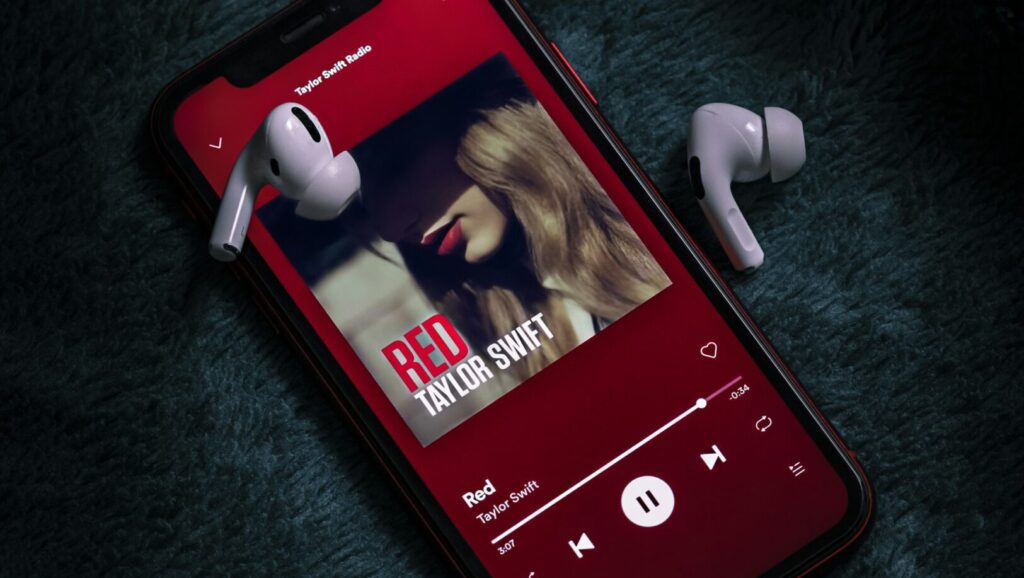
Red (Taylor’s Version) sold 1.14 million copies globally in 2021. In an age of streaming, Swift proved that she could dominate pure sales, even if the tracks weren’t unheard. The daunting, treacherous feat of re-recording soon became one made sacred by the fans. Clad in friendship bracelets and flapper dresses, screaming “F*** the patriarchy!”, Swifts fans have shown up and shown out.
Since the sale to Braun, Swift has repeatedly bid goodbye to her old records forever in melodic eulogies. In ‘It’s Time to Go’, Swift breathily warbles “He’s got my past frozen behind glass, but I’ve got me”.
THE POSSIBILITY OF SWIFT OWNING HER MASTERS
As time passed and the legend of the Taylor’s Version project amassed, thoughts of Taylor being granted the opportunity to buy back her masters meandered to the back of fans’ minds.
Instead of hypothesising that Swift was vying to reclaim her old work by purchasing it, listeners were precisely calculating the days until the re-recordings of the remaining two albums were released. But on 30th May 2025, Swift returned to social media after nearly 6 months to announce that “All of the music [she’s] ever made now belongs to [her].” After negotiations with Shamrock Capital, her life’s work is – 20 years in the making – entirely hers for keeps.
“In campaigning for Swift’s autonomy, young women are campaigning for their own”
In 2019, when the news first broke about the sale of the singer’s masters, I was at the height of my very public Swiftian obsession – I had been a fan since I had seen her sing ‘Crazier’ in Hannah Montana: The Movie. I spent my evenings engaging in online communities on Instagram, Twitter and Tumblr desperately trying to get invited to a secret session. I knew nothing about the inside happenings of the music industry, but I knew one thing: the “carrot-dangling” system Borchetta used for the entirety of Swift’s contract should not be the norm for artists wishing to own their life’s work.
WHAT THIS VICTORY MEANS
Swift was signed at the age of 14 in 2004, an era not renowned for autonomous popstars. A young Swift with no skin in the game would not have been advised against the clause detailing Borchetta’s ownership of her master recordings; being media savvy was not the standard.
However, in the age of social media and celebrity accessibility, the landscape has been dramatically altered; Swift’s message can be amplified to her hundreds of millions of followers, and ripples can be felt throughout the music industry, within which she is now an unquestionable giant.
In 2020, a then 17-year-old Olivia Rodrigo entered into a contract with Geffen Records wherein she negotiated a clause ensuring that she has full ownership of her master recordings. Rodrigo, as a direct result of Swift’s vocalisation of the importance of ownership for artists, was made aware of the issue and conscientiously navigated the formulation of a fair contract with Geffen.
“Swift’s battle for ownership of her master recordings has not just uplifted young musicians, but young professionals navigating other trades.”
In 2022, Zara Larsson bought back her catalogue from TEN Music Group and set up her own label, Sommer House. As iterated by Melissa Ferrick, a songwriter and professor of music at Northeastern University, Swift has “laid the groundwork”, particularly for other young women trying to navigate the modern music industry. “There’s a lot to be said about ownership, particularly as a woman,” Ferrick told the Northeastern Global News , “[and] she’s an incredible businesswoman.”
TAYLOR IS A ROLE MODEL FOR YOUNG ARTISTS
Swift’s battle for ownership of her master recordings has not just uplifted young musicians, but young professionals navigating other trades.
In the recent announcement of the acquisition of her master recordings on her website, Swift praised fans for being “curious about something that used to be thought of as too industry-centric for broad discussion.” As a direct result of Swift’s public plight, supporters have been granted a peek behind the curtain of her seemingly bejeweled life to find that the music industry, like any industry, is not glamorous. In campaigning for Swift’s autonomy, young women are campaigning for their own – it can no longer be acceptable for young creatives to be treated without decency at the behest of executives.
If Swift’s victory can teach us one thing, it’s that the landscape of music as we know it is changing, and it is changing for the better.
READ NEXT:
-
‘SOMETHING BEAUTIFUL’ BY MILEY CYRUS – REVIEW
-
REVIEW: BRYCE VINE’S NEWEST ELECTRIFYING ALBUM ‘MOTEL CALIFORNIA’
-
FROM STAGE TO SCANDAL: KNEECAP, CENSORSHIP AND THE POLITICS OF PROTEST IN MUSIC
Featured image courtesy of Omid Arnin via Unsplash. No changes were made to this image. Image license found here.

