
Soph Johnson
Kneecap’s “Kill Your MP” remarks sparked debate over artistic freedom, political expression and where to draw the line.
Festival organisers dropped West Belfast rap trio Kneecap from a major lineup after their incendiary on-stage comments, thrusting the group into the centre of a national conversation about censorship and protest in music.
As public figures and fellow artists take sides, the controversy raises urgent questions about freedom of speech, accountability and the role of musicians in political discourse.
The Comment That Sparked The Fire
Footage of the rap group is being assessed by counter-terrorism police, as a video has recently emerged of the group from a November 2023 performance, appearing to show one person from the band saying: “The only good Tory is a dead Tory. Kill your local MP.”
The Metropolitan Police are also assessing another video from November 2024, where a band member appears to say “up Hamas, up Hezbollah” during a gig in London.
The UK government has banned both Hamas and Hezbollah, and criminalises expressing support for them.
Similarly, during the band’s Coachella set earlier this month, the group displayed messages about the war in Gaza that they have since received criticism for.
“The rap trio’s remarks had “caused great concern both within the UK Jewish community and wider society'”
The Comment Reactions
A Met Police spokesperson said: “We were made aware of a video on 22 April, believed to be from an event in November 2024, and it has been referred to the Counter Terrorism Internet Referral Unit (CTIRU) for assessment and to determine whether any further police investigation may be required. We have also been made aware of another video believed to be from an event in November 2023.”
These comments, particularly those relating to killing MPs, have gone down negatively with various sectors of their audience, politicians and other high-profile groups.
As an example, the Board of Deputies of British Jews said the rap trio’s remarks had “caused great concern both within the UK Jewish community and wider society”.
Speaking on RTÉ’s Prime Time, the band’s manager Daniel Lambert, said that “moral hysteria” has taken hold and accused critics of holding the band to a higher moral standard than politicians.
Lambert argued that a “concerted campaign” against the group is “solely about de-platforming artists. It’s about telling the next young band, both through the music industry and through the political class, that you cannot speak about Palestine,” he said.
Since these comments went viral, the band have apologised on X to the families of murdered MPs Jo Cox and Sir David Amess.
The band said that “someone deliberately took an extract of footage out of context and is now exploiting and weaponising it as if it were a call to action.”
Kneecap have said on social media that they have “faced a coordinated smear campaign”.
KNEECAP STATEMENT:
They want you to believe words are more harmful than genocide.
Establishment figures, desperate to silence us, have combed through hundreds of hours of footage and interviews, extracting a handful of words from months or years ago to manufacture moral… pic.twitter.com/qZht5532Zf
— KNEECAP (@KNEECAPCEOL) April 28, 2025
Immediate Fallout: Festival Bookings and Institutional Response
Since making these comments, multiple festivals and venues have removed Kneecap from their lineups.
Most notably, the organisers of the Eden Sessions pulled the band from the lineup for the series of live outdoor concerts at the Eden Project in Cornwall.
In addition, Kneecap have had their shows cancelled in Hamburg, Berlin and Cologne.
“It seems clear, based on the current controversy, that the band’s political comments are, at least partly, to blame.”
Eden Sessions said, “the Kneecap show at the Eden Project scheduled for 4 July 2025 has been cancelled.”
Even though the Eden Sessions festival did not give an explicit reason for the cancellation, it seems clear, based on the current controversy, that the band’s political comments are, at least partly, to blame.
The band have since announced on Facebook that it would instead be performing at Plymouth Pavilions on the July date.
Despite the cancellations so far, several politicians have called for organisers to remove the band from more gigs and festivals across the UK.
Tory MP Mark Francois has also argued that the group should not play at Glastonbury, citing the ongoing police investigation.
Speaking on the various gig cancellations, the band’s manager said: “It’s not for us to worry, it’s for us to have the strength of conviction that we did the right thing.”
Earlier in the week, Kneecap’s manager said the band had received “severe” death threats after Coachella.
Artists In Solidarity: Who’s Defending Kneecap And Why?
Several other artists have signed a joint statement in support of Kneecap.
The statement includes various big-name artists, such as Fontaines DC, Annie Mac, Bicep, Massive Attack, Pulp, Paul Weller and Christy Moore are among the artists who signed the open letter, started by Kneecap’s record label, Heavenly Recordings.
The statement explained that there had been a “clear, concerted attempt to censor and ultimately deplatform” the band.
“This raises the question of whether institutions disproportionately scrutinise politically engaged artists, particularly those outside a mainstream Anglo-British framework”
It accused “senior political figures” in Westminster and the UK media of being “openly engaged in a campaign to remove Kneecap from the public eye”.
“As artists, we feel the need to register our opposition to any political repression of artistic freedom,” the statement added.
“In a democracy, no political figures or political parties should have the right to dictate who does and does not play at music festivals or gigs that will be enjoyed by thousands of people.”
What This Means For The Music Industry
This backlash against Kneecap and their removal from multiple gig lineups marks a turning point for how the music industry handles politically charged content.
While festival organisers cite concerns over safety and public decency, critics argue that these decisions reflect a broader institutional unease with radical voices.
This raises the question of whether institutions disproportionately scrutinise politically engaged artists, particularly those outside a mainstream Anglo-British framework. Suppose platforms avoid artists because they deem their messages too provocative or controversial. In that case, the result may be a chilling effect that discourages political expression and reduces the oppositional spirit of protest music.
In this way, the music industry’s response to Kneecap may set a precedent that extends far beyond a single act or comment.
READ NEXT:
-
REVIEW: DUA LIPA & TROYE SIVAN ‘PHYSICAL’
-
ADOLESCENCE: A CRITICAL VIEW OF MODERN-DAY SOCIETY
-
ETERNAL SUNSHINE (DELUXE) – BRIGHTER DAYS AHEAD REVIEW
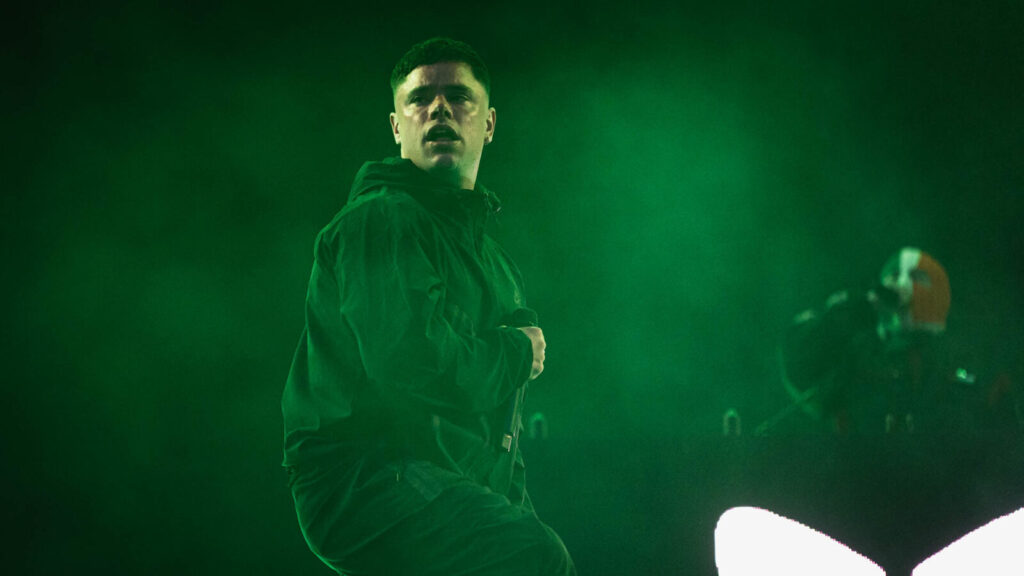
Featured image courtesy of Paul Hudson on Flickr. No changes made to this image. Image license found here.
Soph Johnson


Soph is a self-proclaimed musicophile, hot chocolate connoisseur, and a sort-of polyglot. She is also an avid lover of film photography, movies, and books.